
Fiona & Sandra's Wise Woman's Blog...
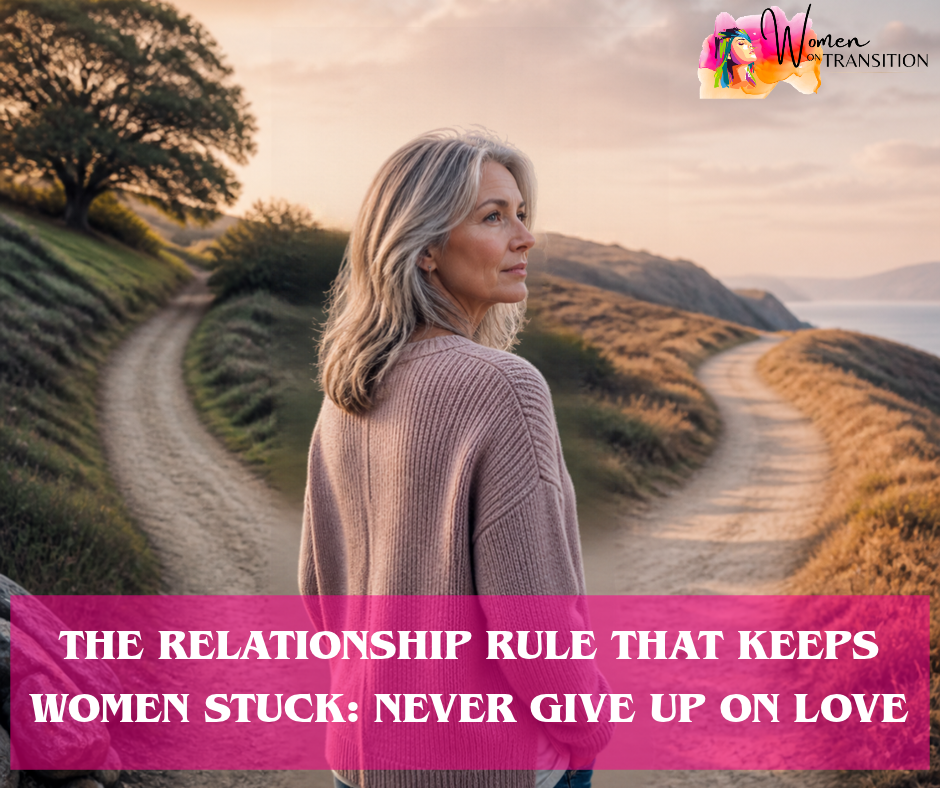
The Relationship Rule That Keeps Women Stuck: Never Give Up on Love
Many women grew up believing that a successful marriage requires hard work, patience and commitment.
And there is truth in that.
Healthy relationships do require effort.
They require communication, compromise, forgiveness and a willingness to work through difficult seasons.
But there is a difference between working on a relationship and working endlessly to keep one alive on your own.
Commitment is valuable. But commitment without reciprocity can become self-abandonment.
This is a distinction more women need to understand.
When Persistence Becomes a Trap
Imagine a woman who has spent twenty-five years trying to improve her marriage.
She reads books.
Suggests counselling.
Attempts difficult conversations.
Changes her behaviour.
Tries to understand her partner's perspective.
Each time things improve briefly, she feels hopeful.
Then the old patterns return.
She tells herself to try harder.
Perhaps she needs to be more patient.
Perhaps she hasn't explained herself clearly enough.
Perhaps the next conversation will finally make a difference.
Her commitment is real.
But so is her exhaustion.
The question isn't whether she has tried hard enough.
It's whether both people are willing to participate in creating a healthier relationship.
The Psychology of Sunk Cost
When we invest years into something, walking away can feel like admitting that the investment was wasted.
Psychologists call this the sunk cost effect.
We may continue investing time, energy or money because we've already invested so much.
In relationships, this can sound like:
"I've spent twenty-five years with him. I can't give up now."
But the years you've already invested cannot be recovered by sacrificing more years to an unhealthy dynamic.
Your history matters.
But it doesn't have to dictate your future.
The Difference Between a Difficult Season and a Harmful Pattern
Every relationship experiences challenges.
A difficult season might involve stress, grief, financial pressure or communication problems that both partners are willing to address.
A persistent harmful pattern is different.
Perhaps one person repeatedly dismisses the other's feelings.
Perhaps apologies are offered, but behaviour never changes.
Perhaps one partner carries the entire responsibility for repair.
The important question is whether there is genuine accountability and sustained effort from both people.
You cannot create mutual intimacy through unilateral effort.
What Emotionally Healthy Commitment Looks Like
Healthy commitment doesn't mean leaving at the first sign of difficulty.
It means being willing to address problems while maintaining your dignity and boundaries.
It means asking for change and observing whether actions follow words.
It means recognising that love alone cannot compensate for a lack of respect, safety or willingness to work together.
And sometimes, despite sincere efforts, two people cannot build a healthy future together.
Acknowledging that reality isn't necessarily failure.
It can be an act of honesty.
A Question Worth Asking
Are you staying committed to the relationship as it actually exists?
Or are you staying committed to the relationship you hope it will eventually become?
That distinction can change how you see everything.
You can honour the years you shared without committing the rest of your life to the same patterns.
You are allowed to value commitment without abandoning yourself to prove it.
If you're ready to understand your relationship patterns, rebuild self-trust and create healthier relationships in your next chapter, discover how we can help:
https://womenontransition.com/links
Fiona May and Sandra Lee x
Divorce Recovery & Life Transition Coaches
Women on Transition