Fiona & Sandra's Wise Woman's Blog...
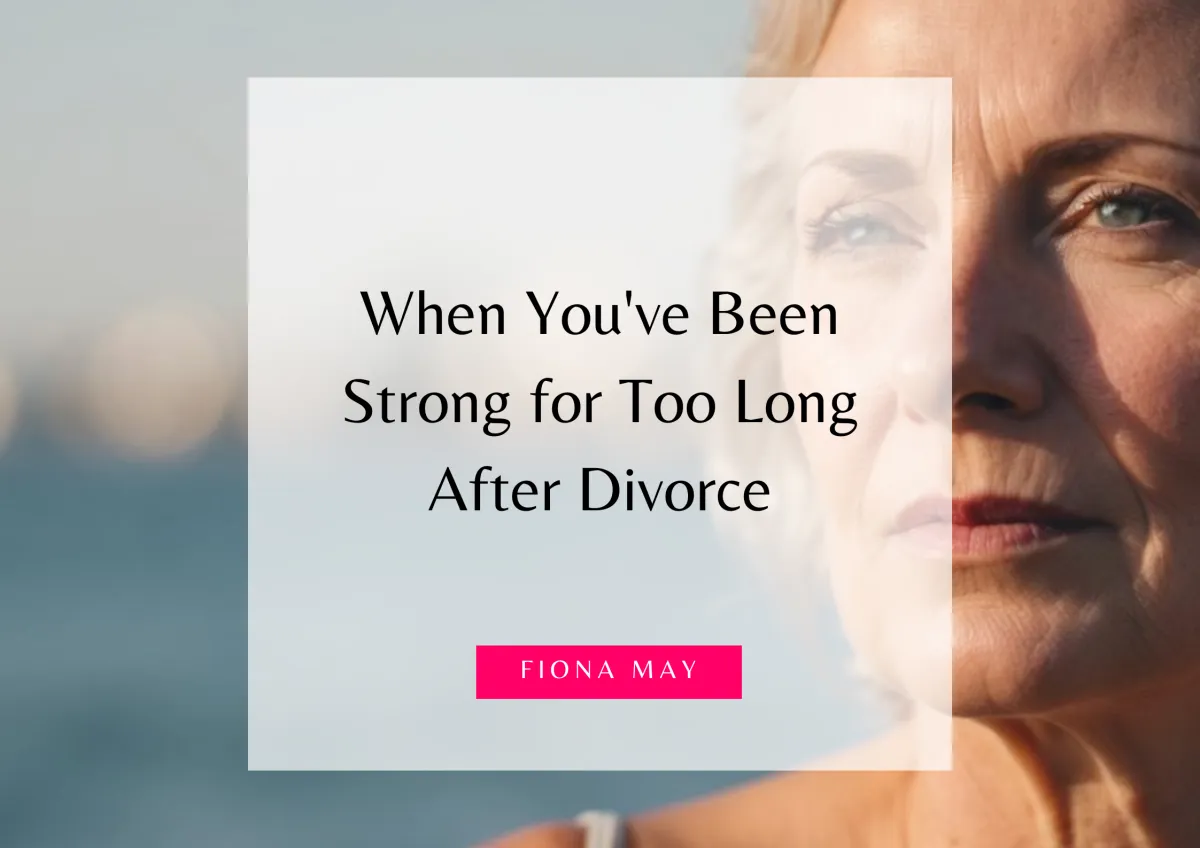
When You've Been Strong for Too Long After Divorce
There is a compliment I think we need to be more careful about giving women.
"You're so strong."
It sounds lovely.
And sometimes it is.
But I've met women who hear those words and want to cry.
Because what they actually hear is:
"Good. You can keep carrying everything."
You handled the separation.
You found the solicitor.
You dealt with finances you may never have managed before.
You reassured adult children who were devastated despite being grown.
You explained things to friends.
You helped ageing parents understand.
You dealt with property, paperwork, bank accounts, belongings and all the strange administrative details involved in dismantling a shared life.
And somewhere in the middle of it all, people looked at you admiringly and said:
"I don't know how you do it."
You probably didn't know either.
You just did.
Then the emergency passed.
And suddenly you were exhausted.
Not "I could use an early night" tired.
Bone tired.
Decision tired.
People tired.
Emotionally tired.
Sometimes even tired of being asked whether you're okay.
Competence Can Hide Distress
One of the biggest misconceptions we have about emotional wellbeing is that functioning means coping.
It doesn't necessarily.
Human beings are remarkably capable of performing while distressed.
We go to work.
Pay bills.
Attend appointments.
Answer emails.
Smile at people.
Make dinner.
The outside world sees competence and assumes wellness.
Meanwhile, internally, the system may be running on fumes.
I call this functional survival.
You're functioning beautifully.
But you're not necessarily flourishing.
The Woman Who Carries Everything
Many women didn't suddenly become over-responsible during divorce.
They had been practising for decades.
You may have been the person who remembered birthdays.
Organised Christmas.
Booked holidays.
Maintained friendships.
Noticed when someone was upset.
Smoothed disagreements.
Kept track of medical appointments.
Managed the emotional temperature of the household.
Much of this is called emotional labour.
It is real work.
It simply doesn't appear on a bank statement or job description.
And when you've carried it for decades, something interesting can happen.
Being needed becomes intertwined with being valuable.
So even after divorce, you continue carrying.
Adult children.
Parents.
Friends.
Work.
Your ex's feelings.
Sometimes even your ex's administrative incompetence.
"He doesn't know how to do that, so I'll just sort it out."
Sound familiar?
Hyper-Independence Can Look Like Strength
There is another layer I want women to understand.
Sometimes refusing help isn't independence.
It's protection.
If you've repeatedly learned that other people are unreliable, disappointing or emotionally unavailable, your mind may develop a simple strategy:
"I'll do it myself."
Initially, that feels empowering.
And sometimes it genuinely is.
But when "I'll do it myself" becomes "I must do everything myself", independence turns into isolation.
You stop asking.
You stop expecting.
You stop receiving.
And because you're capable, everyone assumes you don't need anything.
One woman said to me:
"I've become so good at not needing anyone that I don't know how to let anyone care for me."
That sentence contains enormous insight.
Receiving Is a Skill Too
We're very good at teaching women to give.
Give time.
Give love.
Give support.
Give another chance.
Give people the benefit of the doubt.
But receiving?
That's harder.
Receiving requires vulnerability.
It means allowing somebody else to contribute.
It means admitting:
"I can't carry this today."
And if you've built an identity around competence, that can feel surprisingly uncomfortable.
So try something small.
When somebody offers help, resist the automatic:
"No, no, I'm fine."
Pause.
Ask yourself:
"Would accepting this make my life slightly easier?"
If the answer is yes, try saying:
"Thank you. That would actually be lovely."
That tiny sentence can be revolutionary.
Rest Isn't Something You Earn
Another belief I see constantly is that rest must be justified.
I'll rest when the house is sorted.
I'll rest when the divorce is final.
I'll rest when Mum's appointment is done.
I'll rest when everyone else is okay.
There will always be another task.
Rest cannot remain the prize you receive when life stops requiring you.
It needs to become part of how you live.
And I'm not talking only about sleep.
Emotional rest might mean spending time with people who don't require you to perform.
Not answering immediately.
Having an afternoon with no purpose.
Turning your phone off.
Doing something badly because you enjoy it.
Sitting beside the ocean without turning the experience into a personal-development exercise.
You are allowed to exist without improving yourself every minute.
Resilience Isn't How Much You Can Endure
I would love us to change how we define strength.
Strength isn't endlessly carrying more.
Sometimes strength is putting something down.
Strength is saying:
"That's not mine to fix."
Strength is letting an adult child experience an emotion without rushing to remove it.
Strength is allowing your former partner to deal with the consequences of his own choices.
Strength is asking a friend for help.
Strength is admitting:
"I'm having a difficult week."
Strength is understanding that needing support doesn't cancel your independence.
It makes you human.
What If the Next Version of You Doesn't Carry So Much?
This is the question I want you to consider.
You've already proven you can survive difficult things.
Do you really need to spend the next twenty years proving it again?
What if the next chapter isn't about becoming stronger?
What if it's about becoming lighter?
Imagine entering a room without immediately assessing who needs something from you.
Imagine having energy left at the end of the day.
Imagine friendships where you receive as much care as you give.
Imagine making decisions based not only on what you're capable of doing, but on what you actually want to carry.
That is a different definition of strength.
And perhaps a healthier one.
Key Takeaways
Functioning well doesn't always mean you're emotionally well.
Years of emotional labour can become visible only after the crisis ends.
Hyper-independence can develop when relying on others hasn't felt safe.
Receiving support is an emotional skill, not a weakness.
Recovery may require carrying less rather than becoming stronger.
If you've spent years being everyone's strong woman, I'd love you to experience what happens when somebody helps support you.
At our Reset & Shine 3-Day Experience, Sandra and I create space for women to step away from daily responsibilities, understand the patterns they've been carrying and learn practical emotional tools for the life ahead.
You don't need to arrive confident.
You don't need to have everything sorted.
You can simply arrive as you are.
Discover Reset & Shine:
https://bit.ly/ryl-fs
If you can't attend an event, our online courses allow you to begin building those skills from home, at your own pace.
Explore our online courses:
https://womenontransition.com/courses
You've been strong for a very long time.
Perhaps your next chapter can teach you something equally important:
How to be supported.
With warmth,
Fiona May