Fiona & Sandra's Wise Woman's Blog...
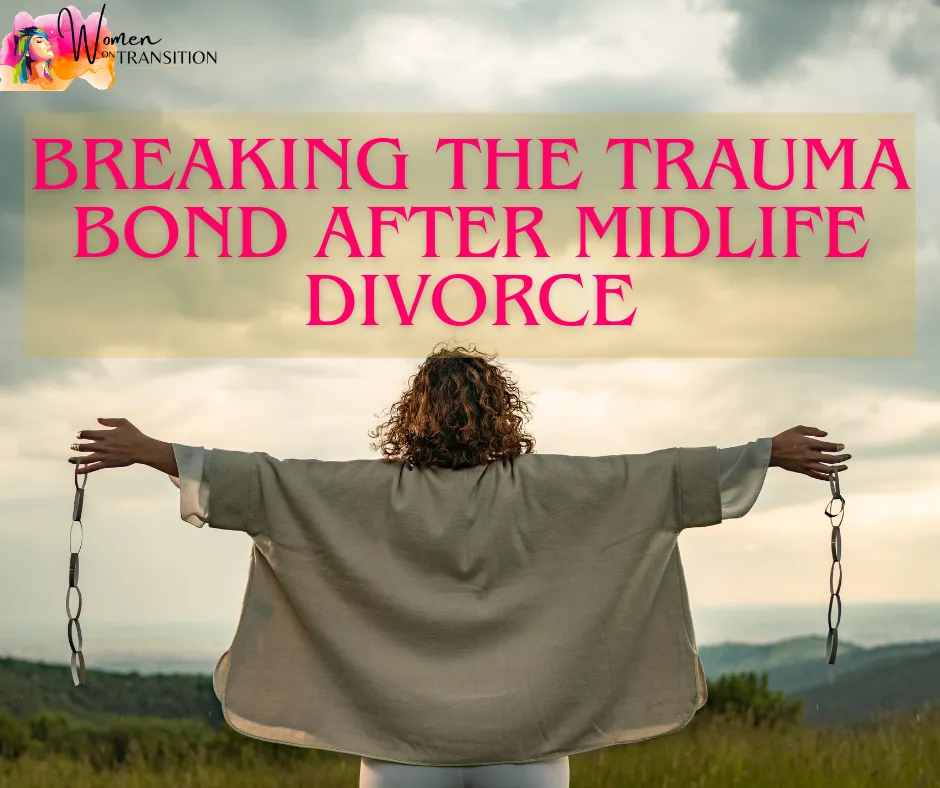
Breaking the Trauma Bond After Midlife Divorce
If you’re a midlife woman who’s finally left a painful, confusing, or toxic marriage — yet still feels emotionally hooked to your ex — please know this:
There is nothing wrong with you.
You’re not weak.
You’re not “failing”.
You’re not imagining it.
You may be experiencing something far more powerful — and far more common — than you realise:
A trauma bond.
And until you understand how trauma bonds work, breaking free feels impossible… no matter how intelligent, accomplished, or self-aware you are.
Let’s walk through this with compassion and clarity.
What Is a Trauma Bond? (And Why It Feels Like Emotional Superglue)
A trauma bond is formed when a relationship cycles between:
pain (criticism, withdrawal, manipulation, rejection)
and temporary relief (affection, apologies, intimacy, false promises)
This rollercoaster of highs and lows conditions your brain to cling to the relationship…
even when you logically know it’s harming you.
Your nervous system becomes addicted to the “maybe next time” feeling —
the hope that the next good moment will make up for the pain.
This is not love.
This is emotional conditioning.
And breaking it requires strategy, not willpower.
Why Trauma Bonds Are Especially Hard to Break in Midlife
You’ve invested decades.
Shared a home, children, finances, identity, and history.
You’ve poured so much of yourself into a relationship that leaving doesn’t just feel like a breakup…
It feels like losing part of yourself.
You may fear:
“What if I end up alone?”
“What if this is the best I’ll ever get?”
“What if I’m too old to start again?”
“What if I can’t trust myself to choose better next time?”
These fears keep thousands of brilliant women emotionally tied to men who depleted them.
But once you understand the mechanics of the trauma bond, everything shifts.
Let’s talk about how to start breaking that emotional chain.
STRATEGY 1 — Awareness: Exposing the Pattern That’s Controlling You
You cannot break what you cannot see.
And trauma bonds live in the shadows of emotional confusion.
Ask yourself:
Do I miss him, or do I miss the “high” after the low?
Do I feel calmer without him, or more anxious?
Do I see the full picture, or just the good moments?
Do I want him… or the version of him I hoped he’d become?
Write your answers down.
When the truth is on paper, the spell starts to break.
This is the beginning of emotional freedom.
STRATEGY 2 — Regulate the Body, Not Just the Mind
Talk alone cannot break a trauma bond.
The bond lives in your nervous system, not your logic.
Your body was trained to:
brace for conflict
crave relief
respond to his moods
prioritise his reactions
manage emotional chaos
That wiring doesn’t disappear just because the marriage ends.
You need tools for:
grounding
breathwork
emotional regulation
interrupting spirals
calming your internal alarm system
When your body calms, your mind regains clarity.
This is how you reclaim control from old emotional programming.
STRATEGY 3 — Rebuild Healthy Connection (This Is the Missing Step)
You cannot break a trauma bond in isolation.
Your nervous system is wired for connection —
So if you don’t consciously cultivate healthy bonds,
Your brain will cling to the unhealthy one simply because it’s familiar.
You must create:
supportive friendships
gentle community
emotionally safe spaces
connection that nourishes you
coaching that helps you rebuild your identity
This replaces the toxic emotional “hook” with real stability.
Healthy connection breaks unhealthy attachment.
The Truth No One Tells Midlife Women
You don’t struggle because you miss your ex.
You struggle because your nervous system doesn’t yet feel safe without the pattern.
But patterns can be healed.
Nervous systems can be retrained.
Hearts can become whole again.
You’re not starting from scratch.
You’re starting from wisdom.
And you have far more power than you realise.
You Can Break This Bond — and We Can Help You Do It
This is exactly the work we specialise in at Women On Transition.
We’ve helped thousands of midlife women break trauma bonds, rebuild emotional strength, and rise into the next chapter of their lives with clarity, confidence and emotional sovereignty.
If you’re ready to heal this pattern — gently, deeply, and with expert guidance — we’d love to support you.
👉 Get information on how we can help you here:
https://bit.ly/m/Women-On-Transition
You don’t have to suffer silently.
You don’t have to untangle this alone.
Your freedom starts the moment you decide you deserve it.
By Fiona May – Women On Transition
PS. Join Australia’s #1 Divorce Recovery and Life Transition Coaches, Sandra Lee and Fiona May, at the “RESET Your Life and Shine” 3-day Events around Australia in 2026.
Subsidised Early Bird Tickets available now: https://bit.ly/ryl-fs