Fiona & Sandra's Wise Woman's Blog...
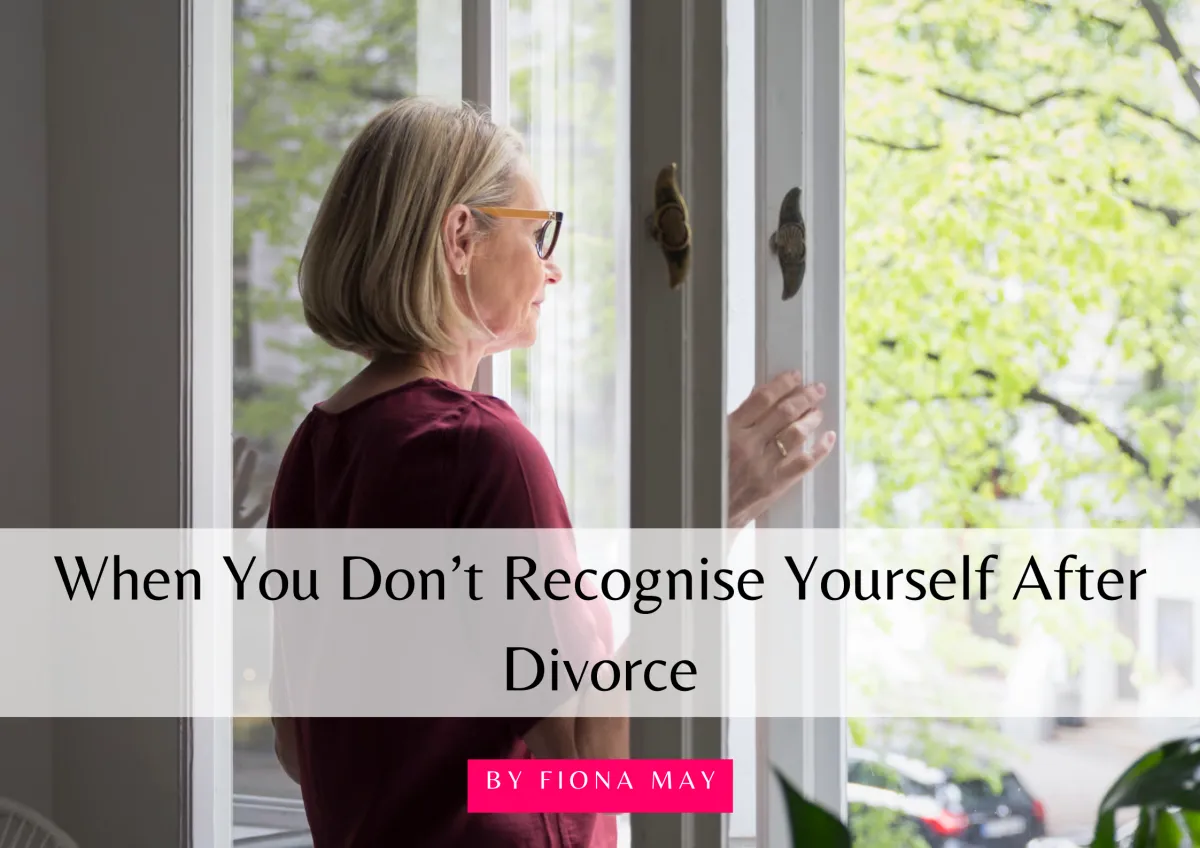
When You Don’t Recognise Yourself After Divorce
One of the quiet shocks of separation or divorce in midlife is how unfamiliar your own inner world can suddenly feel.
Women say things like,
“I don’t recognise myself anymore,”
and immediately assume something has gone wrong.
In truth, something has finally stopped.
What Actually Changed After the Marriage Ended
For many women, long relationships require constant emotional accommodation.
You learn to:
Read the room
Anticipate moods
Manage your responses
Adjust yourself to keep things stable
Over time, this becomes automatic.
Your true reactions don’t disappear — they go underground.
When the relationship ends, those adaptive patterns lose their job.
And when the nervous system no longer needs to orient around someone else, it pauses.
That pause can feel like:
Emptiness
Confusion
Restlessness
A strange inner quiet
This isn’t a loss of identity.
It’s the absence of constant adjustment.
Why This Phase Feels So Unsettling
The psyche needs time to reorganise when it’s no longer tracking another person.
Without that external reference point, women often feel unanchored — not because they’re broken, but because their system is recalibrating around truth rather than adaptation.
This is why rushing to “find yourself” often backfires.
The self that’s emerging doesn’t respond to pressure, productivity, or performance.
She responds to safety.
And when safety is present, clarity returns naturally.
Quietly.
Gently.
Honestly.
That’s exactly what our RESET Your Life & Shine 3-Day Events are built for.
Women over 40 and 50 leave understanding themselves on a level they have never reached before — emotionally, physically, and neurologically.
This is not therapy.
Not motivation.
Not surface-level healing.
It’s a trauma-informed, compassionate space designed specifically for women navigating divorce and life transitions in midlife.
👉 Find a 2026 RESET Your Life & Shine 3-Day Event near you:
https://bit.ly/ryl-fs
If you can’t attend in person, connect here:
✨ Connected Women’s Community:
https://WomenOnTransition.com/gllr
✨ Free Emotional Training:
https://womenontransition.com/free-training
✨ Book a Free Call:
https://bit.ly/FreeLTCall
You’re not disappearing.
You’re reorganising around who you truly are now.
— Fiona May
Women On Transition